What actually catches people out — and how we work around it
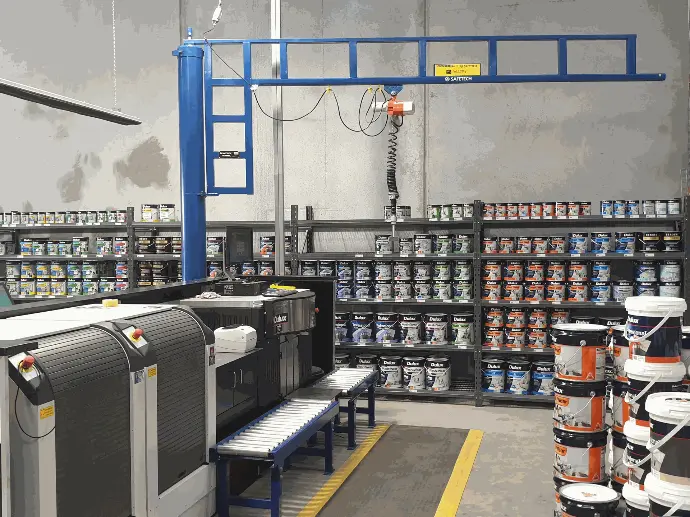
Installing a jib crane is genuinely simple work. I've been putting Gorbel workstation cranes in for years now and the steps rarely change.
What changes is the site.
Nearly every problem I've run into has come from the building, not the crane. So here are the things worth thinking about before the truck turns up — because every one of them is easier to solve on paper than on the day.
1. The floor is the whole job
The single most important part of a jib crane install is the footing. Everything else can be worked around; this one can't.
A free-standing jib doesn't just push straight down. When there's a load out on the end of that arm, it's trying to tip the post over — and that overturning force goes into your slab. A standard warehouse floor is poured to carry stock and forklifts driving across it, not to resist a crane trying to lever itself out of the ground.
So the question is never "is there concrete there?" It's "is there the right concrete there?" The crane manufacturer publishes a foundation requirement for each model and capacity, and that's what the slab has to meet — thickness, reinforcement and all.
Sometimes the existing slab is fine. Sometimes we cut it out and pour a proper pad. Knowing which, before we arrive, is the difference between a one-day install and a three-week delay while concrete cures.
2. What's underneath it
Once you know you're drilling or cutting, the next question is what's down there. Drainage, conduit, hydraulic lines, data — all of it tends to run where nobody remembers.
It's worth asking the site for slab drawings early. If nobody has them, scanning the area is cheap compared with putting a core through a live service.
3. Getting the post into the building
This is the one I actually enjoy. The crane arrives, and the post has to get from the truck to a spot that's often right in the middle of a working factory.
Some sites have a forklift. Some have a pallet trolley. Some have nothing at all, and you stand there with a coffee working out what's possible.
A heavy-duty two-wheel hand trolley has got me out of more of these than anything else — lay it down, roll the post on, wheel it in around the obstacles. Simple, and it's saved entire days.
The point is: have the conversation about access before install day, not on it.
4. Getting the arm up in the air
The post is the awkward one to move. The arm is the awkward one to lift.
Forklift, scissor lift, sometimes a duct lift brought in specially — it depends entirely on what the site can offer and how much headroom there is. What it can't depend on is improvising.
Lifting the arm safely means safe for whoever's installing it and safe for everyone still working around us. If that means a shutdown window or coming in after hours, that's a far better answer than rushing it.
5. Level matters more than people expect
Once the post is standing, it has to be plumb — genuinely plumb, not near enough.
Here's why. If the column leans even slightly, the arm will drift. Let it go and it swings to the low side on its own, every time. The operator ends up fighting it all day, and a crane that's supposed to make the work easier makes it harder instead.
Same story with the footing bolts. They get done up as tight as all heck — rattle gun, or a podgy bar with a leverage bar on it — because you don't want any movement appearing later when a real load goes on.
6. The things that get forgotten
A few that turn up again and again:
Where the arm sweeps. A jib doesn't stay still. Swing it through its full arc on the drawing and check what's in the way — racking, roller doors, walkways, another crane.
What's overhead. Sprinklers, lighting, ducting and roof trusses all live in the space the crane wants.
Power. Electric hoists need a supply and an isolator, in a sensible spot. Worth sorting with the sparky before install day, not after.
Who else is on site. If production can't stop, we plan around it — but we need to know that early.
None of this is difficult. It's just far cheaper to answer in advance.
If you're thinking about a jib crane, the most useful thing you can do is send us a photo of the spot and tell us what you need to lift. Most of the questions above get answered from that one conversation.
Thinking about one for your site?
Send us a photo of the location and what you need to lift, and we'll tell you what's involved.
Call 0434 373 049
Or text 0497 389 848 for a prompt response